Vet News: Program Returns Wounded Guard, Reserve Troops Home to Recover
WASHINGTON, May 24, 2005 – When wounded active-component soldiers get sent home from a deployment for medical care, they’re generally treated directly at their home bases.
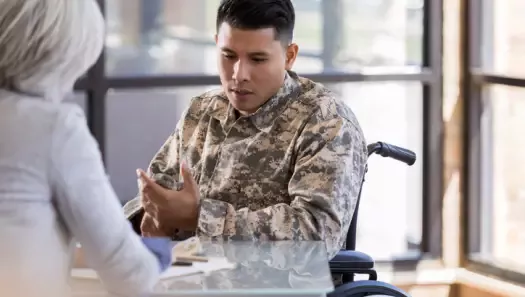
Not so for their reserve-component counterparts. Typically they return to their mobilization stations and get assigned to a medical hold company. There, sometimes hundreds or even thousands of miles away from their homes and families, they receive follow-on medical care that can stretch out for months.
The Army has come up with a solution that’s proving to be the best medicine of all: Community-Based Healthcare Organizations.
These new offices arrange for wounded troops to live at home while getting medical care in their communities through a military facility or civilian Tricare provider, explained Lt. Col. Linda Womack, commander of the CBHCO here.
"We’re getting these soldiers off the installations and back into their homes with their families," said Womack, whose CBHCO office here is among eight nationwide. "This is the best thing the Army has done in a long time for the Reserve and Guard."
Experience shows that troops recover faster when their friends and families are around to support them, she said.
"The best care for them is when they can go home and be with their own families and sleep in their own beds," agreed 1st Lt. Kevin Hurtt, the unit’s executive officer.
The arrangement takes a lot of the stress off families of wounded Guard and Reserve troops too. Womack said she’s heard many stories about spouses quitting their jobs and booking hotel rooms so they could be near their loved ones recovering from injuries far from home.
The CBHCO program also helps relieve pressure on medical facilities and installations, said Lt. Col. Jeanie Mencer, a nurse practitioner.
Now, while living at home, participants can frequently get treatment from their own family doctor, provided that doctor participates in Tricare, said Lt. Col. Toni Walters, a case manager who arranges participants’ primary and specialty care.
But for participants, signing on for the program means more than being idle between doctor’s appointments. Each gets a temporary-duty assignment near home and reports for duty every day, Womack explained.
Womack’s office identifies duty sites, within 50 miles of servicemembers’ homes, and lays out the groundwork about what soldiers can and can’t do due to their medical profiles. Typically, troops do administrative work, answer phones, conduct inventories, even help local recruiters, she said.
Col. Nancy Clark, a CBHCO case manager supervisor, said keeping soldiers on duty "adds to their sense of purpose and usefulness" as they recover, while benefiting the units they serve.
"But they know that their first job is to get better," Mencer said.
Accountability is a big issue. Sgt. 1st Class Demetrius Smith, platoon sergeant at the CBHCO, calls soldiers at their worksite each day to conduct what Womack calls a "telephone formation."
"We can’t see them face to face every day, but we can check in to make sure they’re on the job and see how they’re doing," she said. It’s also a way to identify any problems the soldier is having during recovery that the CBHCO staff can help with.
Just wrapping up its first year of operation, the CBHCO staff here is managing 275 soldiers’ health care, and Womack said the program is getting "nothing but positive feedback" from participants.
"This program is just great!" said Sgt. 1st Class Gary Weston, a Missouri National Guardsman who just signed on with the program.
Weston’s deployment to Baghdad, Iraq, was cut short due to severe back injuries that worsened with constant wear of a flak vest. Back at his mobilization station at Fort Leonard Wood, Mo., he started undergoing physical therapy and traction. Each weekend, he drove two-and-a-half hours to his home to see his family -- something he acknowledges wasn’t the best medicine for his ailing back.
Now that he’s joined the CBHCO program, Weston is able to live at home, get his medical care locally, and continue to contribute in whatever way he can to help his fellow guardsmen still in Iraq.
"With this program, everyone is a winner all the way around," he said.
SOURCE: VNIS