Cover Story: Heroes Meet Heroes 2026 | WeSalute

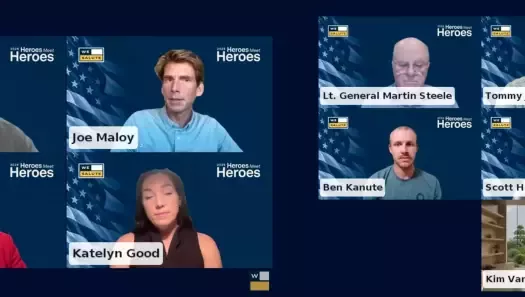
On November 6, WeSalute hosted its 14th annual national live-streaming event, "Heroes Meet Heroes," uniting United States military veterans with world-class Olympic and elite athletes. Moderated by WeSalute co-founder and Chairman Scott Higgins — an Army veteran — the event carries forward the vision conceived by WeSalute CEO Lin Higgins to bridge the military, athletic, and civilian communities.
Timed to celebrate National Veterans and Military Families Month, Veterans Day, and the 251st birthday of the U.S. Marine Corps, the 2026 broadcast featured decorated combat leaders, world-champion competitors, and public advocates exploring resilience, mental health, career transition, entrepreneurship, and the evolving nature of service.
"Olympians and veterans share a lot in common: great determination and success as well as service to our country," Scott Higgins noted in his opening statement. "These panelists share a bond of determination, resilience, and dedicated service to our nation."
The 2026 Roll Call
The 2026 broadcast featured two distinct panels bringing together figures from military command, Olympic arenas, corporate leadership, and mental health advocacy.
Veteran panelists included:
- Gerry Byrne (Decorated Marine Corps Vietnam veteran, Vice Chairman of Penske Media Corporation, and WeSalute Board of Advisers member)
- Lieutenant General Martin Steele (USMC, Ret.) (Former Marine Corps Chief Operating Officer, co-founder of Reason for Hope, and WeSalute Board of Advisers member)
- Joshua Peyton (Former U.S. Army Captain, Airborne Ranger, and co-founder/CEO of the Veterans Golfers Association)
- Tommy Jones (Retired U.S. Army First Sergeant and Director of Military Engagement at Zero Mills)
- Michael Quiello (Former U.S. Marine Corps pilot and Head of Safety, Security, and Operational Excellence at Avelo Airlines)
- Dr. Brigadier General Loree Sutton (Retired US Army Brigadier General, pioneering psychiatrist, and former Founding Commissioner of the NYC Department of Veterans' Services)
Athlete panelists included:
- Priscilla Loomis (2016 Track & Field Olympian, three-time Hall of Fame inductee, and host of Priscilla in the Morning)
- Joe Maloy (2016 U.S. Olympic Triathlete, ITU World Champion, and Acuvo executive)
- Katelyn Good (Four-time World Championship figure skater and founder/Mental Performance Coach at Undeniably Good)
- Kim Vandenberg (2008 Olympic Bronze Medalist in swimming and clinical psychology graduate student)
- Ben Kanute (Rio Olympic Triathlete and holder of the fastest American Ironman distance record)
Dual-role panelists included:
- Sally Roberts (Two-time World Bronze Medalist in wrestling, U.S. Army combat veteran, and founder/CEO of Wrestle Like a Girl)
- Dr. Phil Shinnick (U.S. Air Force Veteran, 1964 U.S. Olympian in Long Jump, and integrative medical practitioner)
WeSalute extends special thanks to presenting benefit partner Avis Budget Group, along with long-standing corporate sponsors Wyndham Hotels & Resorts, 1-800-Flowers.com, IMAX, Delta Air Lines, American Airlines, Aura, and Logitech.
Cognitive Mastery: Mental Toughness in Sports and Combat
Elite athletic performance and combat survivability rely on total control over one's psychological environment. Panelists across both sessions rejected the idea that high performers are naturally immune to fear, providing concrete methods for cognitive reframing instead.
Priscilla Loomis noted that roughly 75% of elite athletics occurs "between the ears." "Neuroscientists discovered something about your brain: it doesn’t care if your thoughts are true, it just believes whatever you repeat," Loomis explained. "Write out exactly what you want — not what you're unable to do, but what you are going to do."
Mental performance coach Katelyn Good reinforced this principle, warning against negative goals like "don't fail." By substituting negative warnings with precise, affirmative instructions, performers direct their neural pathways toward flawless execution. Good also detailed using an "alter ego" to manage high-stakes transitions — a tactic mirrored by a military client who used a physical totem (switching to cargo shorts in his garage) to transition from combat commander to supportive dad at home.
Military panelists described a matching approach for physical and emotional stress. Reflecting on his training at U.S. Army Ranger School, Josh Peyton recalled that the deciding factor for the 19 out of 350 candidates who graduated was not just fitness, but tactical goal segmentation and micro-marking progress.
Navigating Military Career Transition and Veteran Entrepreneurship
Transitioning out of a uniform represents a massive shift in personal identity. Triathlete Joe Maloy shared that elite competitors often confuse what they do with who they are, redefining authenticity not as a reflection of past achievements, but as an ongoing commitment to who one chooses to become.
In business, military discipline translates directly to commercial success. Michael Quiello described how Marine Corps grit helped launch Avelo Airlines, pairing clear vision with a team that refuses to accept defeat. Tommy Jones outlined how military staff organization directly maps to small business ownership:
- S1 (Personnel): Managing team culture and leadership development.
- S2 (Intelligence): Market analysis and operational risks.
- S3 (Operations): Standardizing workflows and quality control.
- S4 (Logistics): Supply chain and facility maintenance.
Gerry Byrne stressed that corporate America must do more than say "thank you for your service." He urged business leaders to harness veteran talent, noting that a 20-year-old corporal leaves the military with the equivalent of an "MBA in leadership," rooted in integrity and accountability.
Healing Invisible Wounds: Veteran Mental Health and PTSD Therapies
The conference heavily addressed the veteran mental health crisis, traumatic brain injury (TBI), and suicide prevention.
Josh Peyton highlighted the power of peer connection through the Veterans Golfers Association, which serves over 55,000 members. Over 12 years, the organization has lost only two members to suicide. "Camaraderie and connection are what will drive that number down," Peyton stated.
On a systemic level, Lt. Gen. Martin Steele and Dr. Loree Sutton detailed the work of Reason for Hope, advancing safe access to psychedelic-assisted therapies. Steele reported major legislative progress, including the Freedom to Heal Act and an April 2026 Executive Order streamlining alternative PTSD protocols, noting that traditional pharmaceuticals frequently fail complex trauma.
Combat veteran Sally Roberts delivered a moving account of her own healing, sharing that her PTSD stemmed from surviving a childhood abduction. Roberts reframed recovery as an engaging journey, encouraging survivors to shed shame and embrace emotional processing with childlike wonder.
Service as a Lifetime Commitment
The event concluded with a unified message: service extends far beyond wearing a uniform or competing under a national flag. It is a daily commitment.
Tommy Jones illustrated this by describing his habit of wearing 10 colored rubber bands on his wrist, moving one to the opposite side each time he completes an act of kindness. "I never walk by mistakes, because if you walk by a mistake, you endorse it," he said.
Olympic athletes Kim Vandenberg and Ben Kanute highlighted their responsibility to mentor youth and build resilience in the next generation. Lt. Gen. Steele, reflecting on turning 80, defined service simply: "What do you do with the gift of life? We've been blessed with the gift of life, and it is our responsibility to give back."
In closing, WeSalute co-founder and Chairman Scott Higgins reflected on WeSalute's 26-year history. From building the historic NYC Vietnam Veterans Memorial glass wall to serving over 3 million members today, the founding spirit of honoring American heroes remains stronger than ever.
Summary of Essential Insights
- Mental Discipline is Universal: Elite sports and military combat rely on identical cognitive principles: affirmative internal instruction, micro-goal segmentation, and emotional regulation.
- Identity Transcends Past Titles: Successful transitions require separating self-worth from past titles and redirecting drive toward community impact and entrepreneurship.
- Healthcare Innovation Saves Lives: Addressing veteran suicide requires expanding access to alternative therapeutics and encouraging deep peer connection.
- Service is an Ongoing Practice: True service is lived daily through acts of kindness, youth mentorship, and uncompromising personal accountability.
As WeSalute marks another milestone of honoring American heroes, the 2026 "Heroes Meet Heroes" event stands as a lasting testament to the power of shared resilience, mutual respect, and dedicated service to the nation.
You can watch the two events here: