Vet News: DoD Releases Study on Link Between Agent Orange and Diabetes

Washington, July 23, 2005 -- The Department of Defense released the latest report of the Air Force Health Study on the health effects of exposure to herbicides in Vietnam.
The report includes the strongest evidence to date that Agent Orange is associated with adult-onset diabetes. This supports the findings from earlier reports in 1992 and 1997.
The Air Force Health Study summarizes the results of the 2002 physical examination of 1,951 Veterans, which is the final examination of the 20-year epidemiological study.
The Ranch Hand Study was named after the operation responsible for spraying herbicides in Vietnam between 1962 and 1971 to deny cover and destroy crops of the North Vietnamese Army.
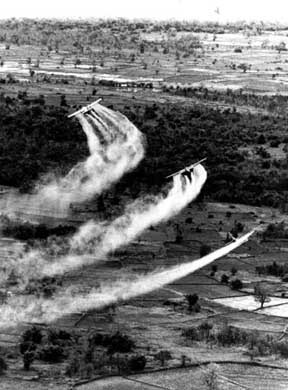 Since the first examination in 1982, the Air Force has tried to determine whether long-term health effects exist in the Ranch Hand pilots and ground crews, and if these effects can be attributed to the herbicides used in Vietnam, mainly Agent Orange and its contaminant, dioxin.
The report, along with many other studies on herbicide and dioxin exposure, will be reviewed by the National Academy of Sciences. Based upon this review, the Secretary of Veterans Affairs can ask Congress for legislation on disability compensation and health care.
Results from the 2002 physical examination support adult-onset diabetes as the most important health problem seen in the Air Force Health Study. They suggest that as dioxin levels increase, not only are the presence and severity of adult-onset diabetes increased, but the time to onset of the disease is decreased.
A 166 percent increase in diabetes requiring insulin control was seen in those with the highest levels of dioxin. This is consistent with the strong evidence found in animal studies.
Cardiovascular disease findings were not consistent, but separate studies have found an increased risk of cardiovascular death in Ranch Hand enlisted ground crews, the subgroup with the highest average serum dioxin.
Overall, Ranch Hand pilots and ground crews examined in 2002 had not experienced a statistically significant increase in heart disease relative to the comparison group. Associations between measures of cardiac function and history of heart diseases and herbicide or dioxin exposure were not consistent or clinically interpretable as adverse.
Other findings included an increase in the frequency of reported acne after service in Southeast Asia in Ranch Hand enlisted ground crew members, but the lack of corresponding patterns of skin lesions observed at the physical examination rendered this finding difficult to interpret.
Finally, several blood tests regarding liver function and blood lipids were elevated and did tend to increase with dioxin level. However, these tests may be elevated for many reasons, do not constitute a disease by themselves and cannot be explained by other findings in the study.
At the end of the 20 years of follow-up, Ranch Hand pilots and ground crews as a group exhibited no statistically significant increase in the risk of cancer relative to comparisons. Differences by military occupation were inconsistent.
Most importantly, the Ranch Hand enlisted ground crews, the subgroup with the highest dioxin levels and presumably the greatest herbicide exposure, exhibited a 14 percent decreased risk of cancer. These results do not suggest that herbicides or dioxin exposure are related to cancer in these Veterans.
The report emphasizes three major limitations to the study. First, the results cannot be generalized to other groups, such as all Vietnam Veterans or Vietnamese civilians, which have been exposed in different ways and to different levels of herbicide. Second, the size of the study makes it difficult to detect increases in rare diseases, thus small increases in rare diseases may be missed by the study. Third, other variables that were not considered in this report could be confounding factors influencing the results.
SOURCE: VNIS - American Forces Press Service